ckd-vs-complete-vehicle-import-strategy
Introduction
If you are an overseas buyer looking to import electric two-wheelers (E2W) from China, you have probably noticed one thing: the same bike can cost you twice as much at the port depending on how you ship it.
That is not a logistics issue. That is a tariff issue.
The global trade environment for Chinese-made E2Ws is shifting fast. Major markets are raising tariff barriers on fully assembled vehicles while keeping preferential rates for knocked-down kits. Choosing the right import strategy is no longer a back-office decision—it is a competitive advantage.
This article breaks down why CKD (Completely Knocked Down) is emerging as the go-to strategy for smart buyers across Southeast Asia, Africa, South America.
First Things First: Know Your Import Terms
Before comparing strategies, let's clarify the three basic import formats.
| Mode | What It Means | What Arrives at the Port |
|---|---|---|
| CBU (Complete Built Unit) | Fully assembled, ready to ride | A complete vehicle — roll it off the container and sell it |
| SKD (Semi-Knocked Down) | Partially disassembled into major modules | A few large assemblies — frame, motor/wheel unit, battery pack, handlebar assembly |
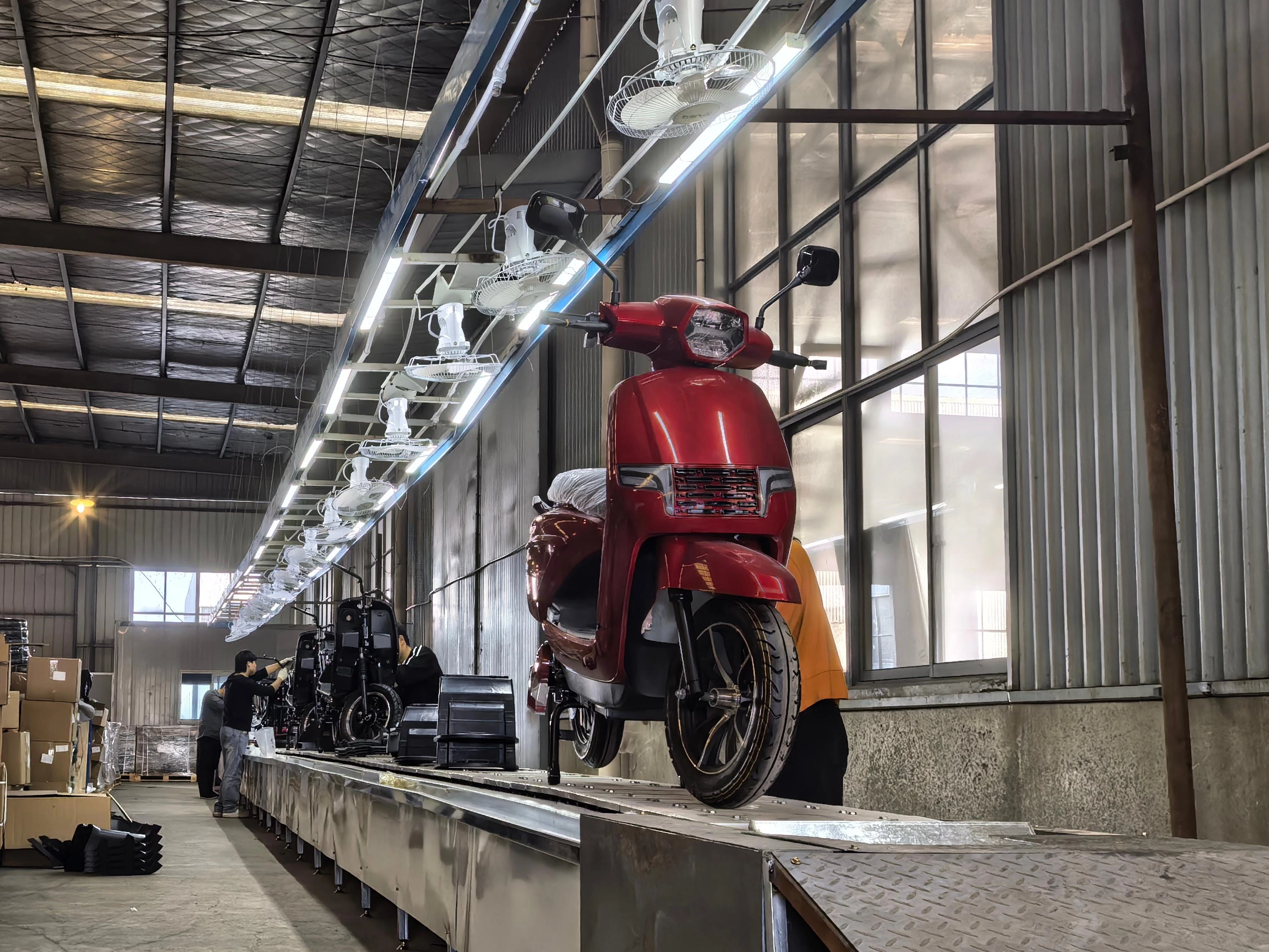
| CKD (Complete Knocked Down) | Fully disassembled to individual parts | Boxes of every single component — from the battery cells to the smallest screws |
Here's the key insight: The more assembly work you do in the country of origin (China), the higher the tariff you'll pay at the destination. The more assembly work you shift to the destination country, the lower your tariff bill.
CKD gives you the lowest tariff rate because the product arrives with minimal "value-added" — it's just a box of parts. The value is added locally through assembly, which is why most countries incentivize this approach with lower duties.
Quick Comparison Table
| Metric | CBU (Complete Vehicle) | SKD (Semi-Knocked Down) | CKD (Fully Knocked Down) |
|---|---|---|---|
| Tariff rate | 30%–45%+ | 15%–25% | 0%–14% |
| Local assembly required | None | Minimal | Full manufacturing setup |
| Investment needed | None | Low | High (facility, equipment, training) |
| Time to market | Immediate | 1–2 weeks | 1–3 months (initial setup) |
| Job creation in target market | None | Low | High |
| Government incentives | None/Low | Moderate | High |
The Global Trend: Tariffs on Complete Vehicles Are Rising Everywhere
Across the world, one pattern is unmistakable: countries are raising tariffs on fully assembled vehicles while keeping parts and components at lower rates.
Governments want to:
-
Encourage local manufacturing and job creation
-
Build domestic supply chains
-
Reduce reliance on foreign assembly
-
Capture more economic value within their borders
For electric two-wheelers specifically, this trend is accelerating. As these vehicles become more popular, governments see them as an opportunity to build local industry — not just import finished products from China.
Region-by-Region Tariff Analysis
Southeast Asia: The CKD-Friendly Zone
Southeast Asian countries are actively promoting local assembly through tariff incentives.
-
Philippines currently applies zero import duty on electric vehicles, making it the most open market in the region—but this applies primarily to CBU units.
-
Indonesia targets 1.8 million electric two wheels by 2025 but enforces strict TKDN local content requirements. Only CKD-assembled units qualify for preferential tax treatment. CBU imports face prohibitively high duties.
-
Thailand maintains tariff advantages for CKD parts imports, making it a viable base for assembly operations.
-
Vietnam has a growing market driven by motorcycle bans, but requires CR Mark local certification, creating a brand-entry barrier.
ASEAN Agreement on Tariffs: CKD parts from China typically face 0%–10% duties, compared to 30%–60% for CBU units in some countries.
ASEAN Tariff Advantage:
Under the ASEAN-China Free Trade Agreement, CKD component tariffs from China to ASEAN countries generally range from 0% to 10% —significantly lower than CBU vehicle tariffs.
| Country | CBU Tariff (Est.) | CKD Parts Tariff (ASEAN) | Strategy |
|---|---|---|---|
| Philippines | 0% (for now) | 0% | Both viable |
| Indonesia | 30%+ | 0%–10% | CKD mandatory |
| Thailand | 20%–30% | 0%–10% | CKD preferred |
| Vietnam | 25%–35% | 5%–10% | CKD preferred |
The takeaway: If you are targeting Southeast Asia, CKD is not just cheaper—it is often the only economically viable path.
South America: The Countdown to 2027
Brazil is the most important case study here. In the first half of 2026, Brazilian E2W imports from China surged 155% year-over-year, accounting for 70% of total exports.
But the party isn't going to last forever.
Brazil's government has laid out an aggressive tariff escalation schedule:
| Period | CBU (Complete Vehicle) | CKD (Full Knocked Down) | SKD (Semi-Knocked Down) |
|---|---|---|---|
| Jan–Jun 2026 | 35% (no quota) | 14% (no quota) | 14% (no quota) |
| Jul–Dec 2026 | 35% (no quota) | 0%* (quota: $463M) | 0%* (quota: $463M) |
| 2027 onwards | 35% (no quota) | 35% (no quota) | 35% (no quota) |
Note: The $463 million zero-tariff quota for CKD/SKD operates on a "first-come, first-served" basis.
What this means: The CKD tax advantage in Brazil is real—but it comes with an expiration date. The USD 463 million quota is a limited window. If you can secure your allocation before the quota fills, you effectively pay zero tariffs on your CKD shipments. But by 2027, all modes will face the same 35% rate.
Strategic implication: Buyers entering Brazil must treat 2026 as a "race for quota." Beyond that, the decision shifts from "CKD vs. CBU" to "whether to build local assembly capacity or exit the market."
Africa: The Fresh Opportunity Opening Up
Cameroon introduced a clear incentive in its 2025 budget: exemption from excise tax on electric vehicles and motorcycles, plus a 50% reduction on the taxable value of imported EVs, batteries, and charging stations. This preferential policy is valid for 24 months.
For buyers using CKD format, this directly translates to lower duty payments on parts and components.
Looking Across Africa
While Cameroon has the most explicit EV-friendly policy, other African nations are watching closely. Countries with growing urban populations and deteriorating air quality — like Kenya, Nigeria, and Rwanda — are likely to follow similar paths.
Other African markets are also showing openness to EV imports, though specific CKD vs. CBU tariff differentials require country-by-country verification. The general trend, however, favors knocked-down imports to encourage local assembly and job creation.
Caveat: The market is nascent. Infrastructure, local assembly capability, and consumer awareness are still developing. But for procurement managers willing to take a calculated risk, the first-mover advantage could be substantial.
The Real Cost Comparison: CKD vs. Complete Vehicle
Let's move beyond tariff percentages to total landed cost —the number that actually matters to your P&L.
Tariff Cost (Direct)
Using China-to-Brazil electric bicycle trade as a benchmark:
| Model | Tariff Rate | Per-Unit Tariff Cost (on $500 FOB) |
|---|---|---|
| CBU (Complete Vehicle) | 45% | $225 |
| CKD (Components) – 2026 | 0% (within quota) | $0 |
| CKD (Components) – 2027 | 35% | $175 |
Savings in 2026: $225 per unit × 1,000 units = **$225,000 tariff savings** by choosing CKD over CBU.
Logistics Cost (Direct)
| Model | Cargo Volume per Unit | Sea Freight Cost (Est.) |
|---|---|---|
| CBU (Complete Vehicle) | ~3.5 CBM | High |
| CKD (Components) | ~2.0 CBM | 40% lower |
Why? CKD components pack more efficiently. You're shipping flat-packed boxes, not awkwardly shaped whole vehicles with empty space. Over a container load, the difference adds up.
Assembly Cost (New Cost with CKD)
| Model | Assembly Cost per Unit | Notes |
|---|---|---|
| CBU (Complete Vehicle) | $0 | No assembly needed |
| CKD (Components) | $15–$40 | Labor + facility + tools |
This is the new cost that CBU doesn't have. But notice: even at $40 per unit, it's significantly less than the $225 you save on tariffs.
Management & Quality Costs (Indirect)
| Model | Complexity Level | Cost Factor |
|---|---|---|
| CBU | Low | Manage one supplier shipping complete units |
| CKD | High | Manage multiple suppliers, packaging quality, logistics coordination |
CKD requires more procurement management effort—tracking hundreds of components, managing packaging specifications, coordinating multi-supplier shipments. These are real costs, but they are fixed and become negligible at scale.
Break-Even Analysis
Here's the key question: At what volume does CKD become cheaper overall?
| Volume (units/year) | CBU Total Cost | CKD Total Cost | CKD Advantage |
|---|---|---|---|
| 100 | $56,500 | $42,000 | +$14,500 |
| 500 | $282,500 | $175,000 | +$107,500 |
| 1,000 | $565,000 | $310,000 | +$255,000 |
| 5,000 | $2,825,000 | $1,400,000 | +$1,425,000 |
Assumptions: $500 FOB per unit, 45% CBU tariff, 0% CKD tariff (2026 quota), $30 average assembly cost per CKD unit.
The takeaway: Even at 100 units per year, CKD is cheaper. At 1,000 units, the savings can fund an entire local assembly operation.
Conclusion: Think CKD First, CBU Second
The global tariff landscape for electric 2 wheels imports is no longer friendly to CBU shipments. Across Southeast Asia, South America, Africa, and the Middle East, the policy direction is consistent: make it expensive to import fully assembled vehicles, and make it cheap to import parts for local assembly.
For buyers, the message is clear:
CKD is not just a tariff-saving tactic—it is a market-access strategy.
The buyers who move early—securing quota allocations, building local assembly partnerships, and designing supply chains around knocked-down kits—will be the ones who thrive.
General Procurement Best Practices
-
Never compare base prices alone — Always calculate total landed cost (tariff + shipping + insurance + local fees + assembly)
-
Build a toolkit of customs brokers — Have local customs experts in each target market who understand classification codes and can spot preferential pathways
-
Factor in assembly capability — Before committing to CKD, verify your local partner has the floor space, tools, and skilled labor to handle assembly quality
-
Start with a pilot — Ship a small CKD batch first. Verify assembly quality and local compliance before scaling
-
Read the policy fine print — "Zero tariffs" often come with conditions—local content percentages, volume commitments, or time limits. Understand them before you commit.