Why Choose Electric Two-Wheelers? Costs & Benefits
The cost of getting from one place to another adds up faster than many people realize. A daily commute, a trip to the market, or a full day of delivery work may seem inexpensive on its own. Over weeks and months, however, fuel, maintenance, and other vehicle expenses can take a significant share of a household's budget or a business's earnings.
That is why electric two-wheelers are attracting growing attention. For many riders, they offer a practical alternative to petrol-powered motorcycles and scooters, particularly when daily travel distances are predictable and affordable charging is available. But are electric two-wheelers always cheaper? The answer depends on more than the price displayed on a showroom floor.
1. Why Is the Cost of Daily Mobility Becoming a Bigger Concern?
Transportation is not simply a way to get around. For commuters, it affects the cost of going to work. For families, it influences everyday spending. For delivery riders and other commercial users, vehicle expenses can directly affect take-home income.
Fuel prices, maintenance requirements, and the frequency of travel all shape the real cost of mobility. A rider who travels only a few kilometers each day has different priorities from someone who spends eight hours on the road. Likewise, a motorcycle used occasionally for household errands has a different cost profile from one used for daily deliveries.
This is where electric two-wheelers enter the conversation. Their appeal is not limited to new technology or environmental awareness. For people who ride regularly, reducing recurring energy expenses can be a meaningful reason to consider switching. The more frequently a vehicle is used, the more important it becomes to understand its total operating cost rather than focusing only on the initial purchase price.
2. Electric Two-Wheelers vs. Petrol Motorcycles: What Does Daily Travel Really Cost?
Comparing electric and petrol-powered two-wheelers requires looking beyond electricity and fuel prices. The purchase price, routine maintenance, battery replacement, and expected period of ownership all matter.
Energy costs: Charging versus refueling
An electric two-wheeler uses electricity to charge its battery, while a petrol motorcycle relies on fuel. The difference in energy cost per kilometer can be substantial, depending on local electricity and petrol prices, vehicle efficiency, battery size, and riding conditions.
Consider a simple illustrative example. Suppose an electric two-wheeler consumes 3 kWh of electricity per 100 km, while a petrol motorcycle uses 2.5 liters of fuel over the same distance. If electricity costs $0.15 per kWh and petrol costs $1.20 per liter, the estimated energy costs would be:
| Item | Electric two-wheeler | Petrol motorcycle |
|---|---|---|
| Energy consumption per 100 km | 3 kWh | 2.5 liters |
| Assumed energy price | $0.15/kWh | $1.20/liter |
| Energy cost per 100 km | $0.45 | $3.00 |
| Energy cost per 10,000 km | $45 | $300 |
Under these assumptions, the electric vehicle saves $2.55 in energy costs per 100 km, or $255 over 10,000 km. These figures are illustrative, not universal market averages. Actual consumption and prices vary by model, country, riding style, and charging method.
Maintenance and replacement costs
Electric two-wheelers generally have simpler drivetrains than conventional petrol motorcycles. They do not require engine oil changes, and they have fewer engine-related components that need routine servicing. Nevertheless, tires, brakes, suspension, bearings, electrical components, and other parts still require inspection and maintenance.
Battery costs also deserve attention. Battery performance gradually changes with age, usage, temperature, and charging habits. Depending on the battery chemistry and the manufacturer's specifications, replacement may become a significant expense during ownership.
Petrol motorcycles have their own maintenance requirements, including engine oil, air filters, fuel-system components, and engine-related servicing. The actual difference depends on the specific vehicles being compared and the quality of available service.
Calculate the total cost of ownership
A fair comparison should include:
-
Initial purchase price.
-
Electricity or fuel.
-
Routine maintenance and repairs.
-
Battery or major-component replacement, where applicable.
-
Insurance, registration, financing, and other relevant ownership expenses.
The total cost of ownership (TCO) is the combined cost of buying and operating a vehicle over a defined period. An electric two-wheeler may have lower running costs but a higher purchase price. A petrol motorcycle may be cheaper to buy yet cost more to operate over time.
The key question is therefore not simply which vehicle is cheaper today, but which option offers better value over the distance you expect to travel and the number of years you plan to keep it.
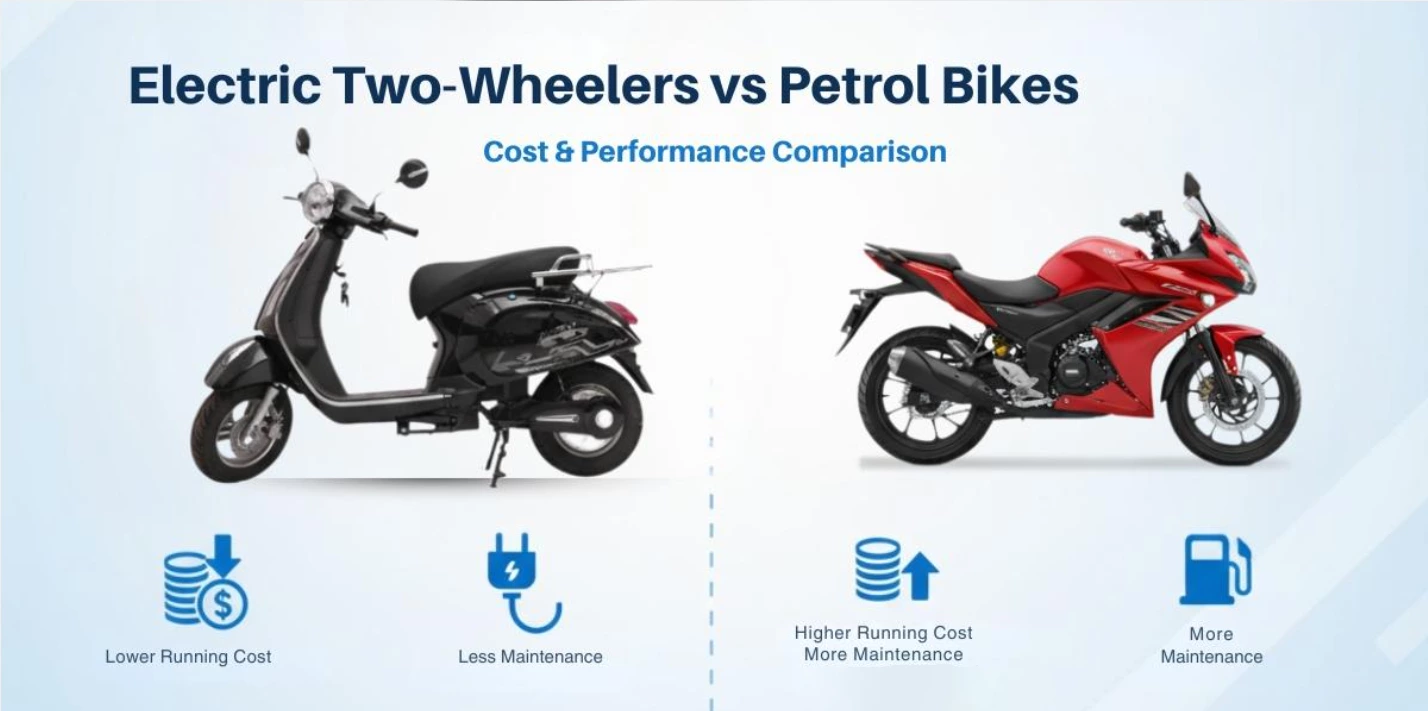
3. Five Reasons More People Are Choosing Electric Two-Wheelers
Lower operating costs are an important part of the story, but they are not the only reason riders consider electric mobility. Convenience, maintenance needs, and suitability for everyday journeys also influence purchasing decisions.
3.1 Lower everyday energy costs
For riders who travel frequently, electricity can cost less per kilometer than petrol. The advantage becomes more noticeable when a vehicle covers substantial daily distances, provided that charging prices remain favorable and the vehicle is energy-efficient.
This is especially relevant for commercial users, whose vehicles may operate for many hours a day. Even modest savings per trip can accumulate over weeks and months.
3.2 Convenient for everyday commuting
Many daily journeys are relatively short and predictable. Commuting to work, visiting nearby shops, or traveling between locations within a town may not require the long range or high speed of a larger vehicle.
For these trips, an appropriately configured electric two-wheeler can provide practical transportation without frequent visits to fuel stations. Its suitability still depends on local road conditions, permitted vehicle speeds, and access to charging.
3.3 Simpler routine maintenance
An electric motor has fewer moving parts than a conventional internal combustion engine. This can reduce certain routine maintenance requirements and eliminate engine oil changes.
However, simpler mechanical construction does not mean maintenance-free ownership. Brakes, tires, battery systems, wiring, and suspension still need proper care. Parts availability and the quality of local service also influence the ownership experience.
3.4 Quiet operation and no tailpipe emissions
Electric two-wheelers operate more quietly than many petrol-powered alternatives, particularly at lower speeds. They also produce no tailpipe emissions while being ridden.
These characteristics can be beneficial in residential neighborhoods and densely populated urban areas. However, the overall environmental impact depends on electricity generation, battery production, manufacturing, and the vehicle's full life cycle.
3.5 More options for different mobility needs
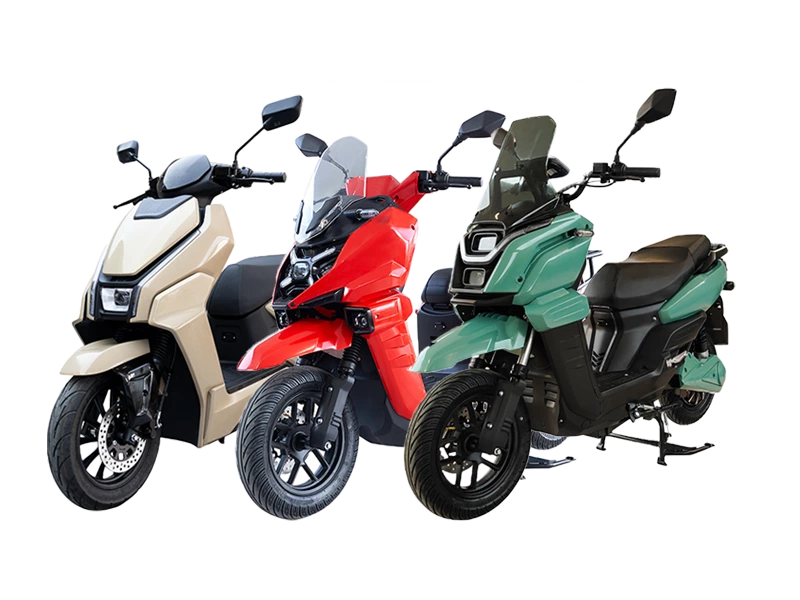
The electric two-wheeler market includes a wide variety of designs and specifications. Buyers can compare motor power, battery chemistry, range, braking systems, carrying capacity, and overall vehicle design according to their intended use.
A commuter may prioritize affordability and sufficient range for daily travel. A delivery rider may focus on durability, payload, and charging time. Families may place greater importance on comfort, stability, and practical carrying capacity.
Choosing the right specification for the job is often more useful than simply choosing the model with the highest advertised range or motor power.
4. Who Benefits Most from Switching to Electric Two-Wheelers?
Electric two-wheelers are not equally suitable for every rider. Their value depends on travel patterns, charging access, local energy prices, and the demands placed on the vehicle.
Daily commuters may benefit when their regular routes fit comfortably within the vehicle's practical range. Charging at home or at a workplace can make daily use easier, although charging arrangements vary by location.
Families and household users may find electric scooters practical for shopping, nearby errands, and other short journeys. The vehicle should still have suitable carrying capacity, stable handling, and safety features for its intended use.
Delivery riders and commercial users often have a different calculation. Vehicles that travel many kilometers each day consume more energy, so the difference between electricity and petrol expenses can become more important. At the same time, charging downtime, battery durability, payload, and service availability need careful consideration.
Fleet operators and small businesses should evaluate not only individual vehicle costs but also utilization rates, maintenance schedules, replacement planning, and access to spare parts. A vehicle with a low energy cost may not be the most economical choice if it spends too much time out of service.
The most suitable buyer is therefore not necessarily the person who travels the least or the most. It is the person whose daily needs match the vehicle's range, performance, cost structure, and charging arrangements.
5. Are Electric Two-Wheelers Always the More Economical Choice?
The honest answer is no. Electric two-wheelers can offer lower running costs, but their overall financial advantage depends on the circumstances.
An electric model may have a higher upfront price than a comparable petrol motorcycle. If annual mileage is low, energy savings may take a long time to offset that initial difference. Where electricity is expensive, charging access is limited, or battery replacement costs are high, the financial case may become less attractive.
Range is another practical consideration. Frequent long-distance journeys, high speeds, heavy loads, and challenging road conditions can increase energy consumption or place greater demands on the battery. Buyers should compare realistic range under their expected riding conditions rather than relying only on a manufacturer's best-case figure.
Local repair infrastructure matters, too. A vehicle that is inexpensive to run may become difficult to own if replacement parts are hard to find or qualified technicians are unavailable. Before purchasing, buyers should check warranty coverage, battery specifications, parts availability, and the cost of routine servicing.
Petrol motorcycles can remain a reasonable choice for riders who need frequent long-distance flexibility, lack convenient charging, or find a comparable electric model too expensive to purchase.
A sensible decision comes from comparing the full cost of ownership against actual usage—not from assuming that one technology is always cheaper.
6. How Is Electric Two-Wheeler Demand Changing Across Markets?
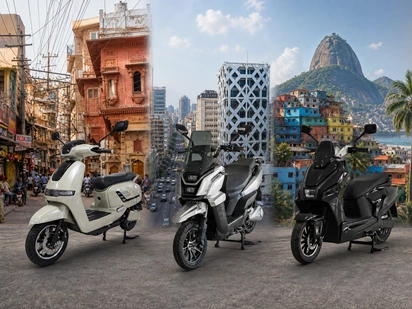
The growth of electric two-wheelers is not uniform across the world. Local fuel prices, government policies, purchasing power, charging access, and established riding habits all influence how quickly consumers adopt electric models.
According to the International Energy Agency's Global EV Outlook 2026, global sales of electric two-wheelers approached 10 million in 2025, increasing by about 15% year on year. Electric two-wheelers accounted for roughly 14% of global two-wheeler sales that year. China remained the largest market, while Vietnam was an important driver of growth in Southeast Asia.
The same report highlights the importance of local conditions. In Vietnam, electric two-wheeler sales rose to around 735,000 in 2025, representing more than one-fifth of the country's two-wheeler sales. In contrast, adoption in Indonesia was much slower, illustrating that a large motorcycle market does not automatically translate into rapid electrification.
Africa offers another example of how commercial use can influence demand. The IEA reported that electric two-wheeler sales across the continent reached around 70,000 in 2025, with growth supported by delivery services, motorcycle taxi operations, financing, and battery-swapping solutions in some markets.
For importers and distributors, these differences matter. A model that fits one market's price expectations, range requirements, and charging arrangements may not be suitable elsewhere. Successful market development requires understanding local buyers rather than treating demand for electric two-wheelers as identical across every country.
7. What Does Growing Demand Mean for Electric Two-Wheeler Dealers?
For importers, wholesalers, and distributors, the shift toward electric mobility creates opportunities—but it also makes product selection more important. The strongest offering is not necessarily the cheapest model or the one with the highest advertised specifications. It is the one that meets local customer needs at a sustainable operating cost.
Start with the intended application. Urban commuters may prioritize affordability, manageable weight, and sufficient range. Delivery businesses may require durable components, higher load capacity, reliable brakes, and convenient charging. Other markets may place more emphasis on battery options, road conditions, or access to replacement parts.
Product reliability should be considered alongside the initial purchase price. Consistent quality, accessible spare parts, clear warranty terms, and responsive after-sales support can influence a dealer's reputation just as much as the vehicle's retail appeal.
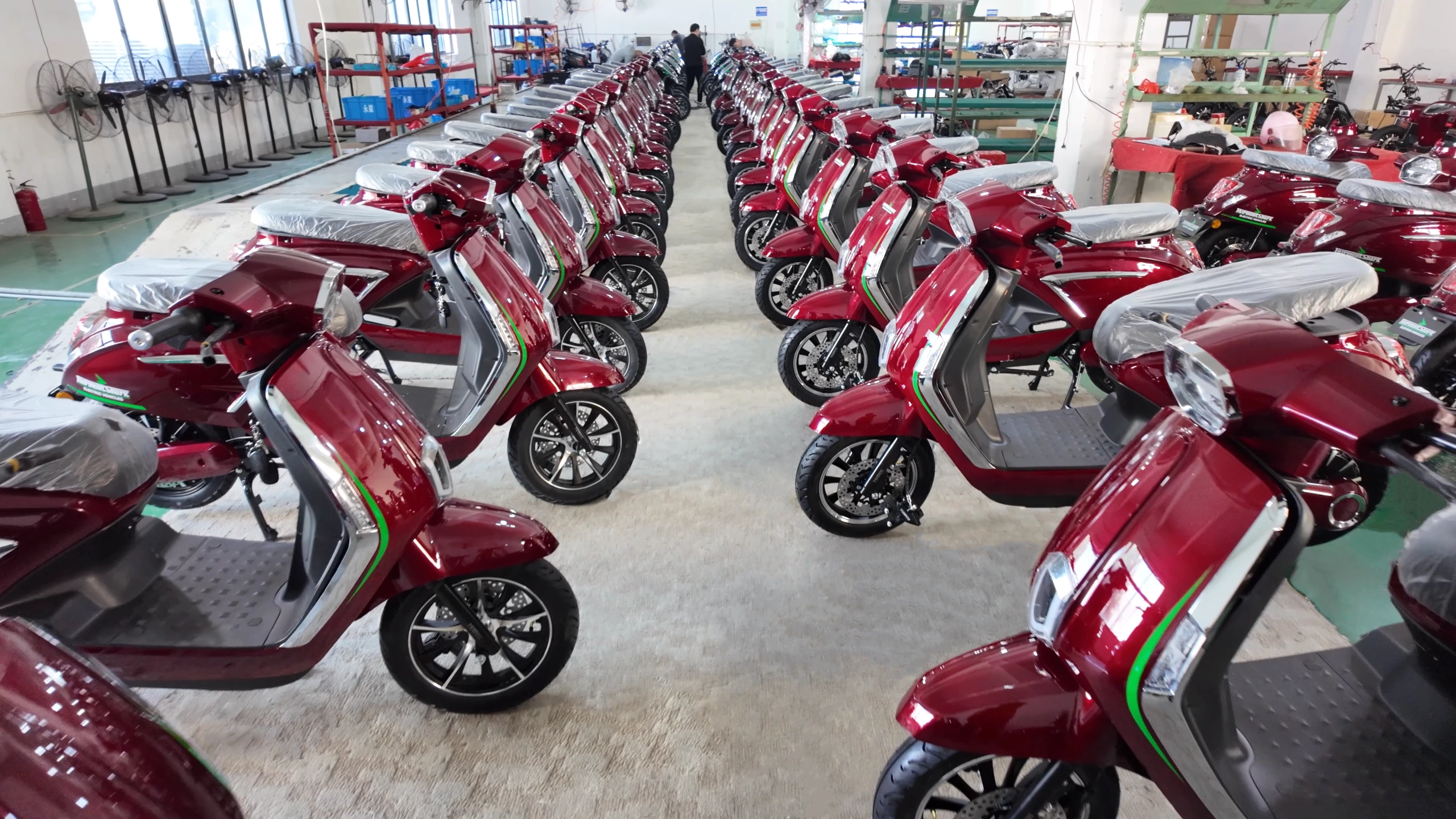
Customization can also help distributors differentiate their offerings. OEM and ODM services, customized colors, decals, branding, and configuration options may help businesses develop products suited to their target markets. The key is to choose changes that meet real customer preferences and comply with local regulations.
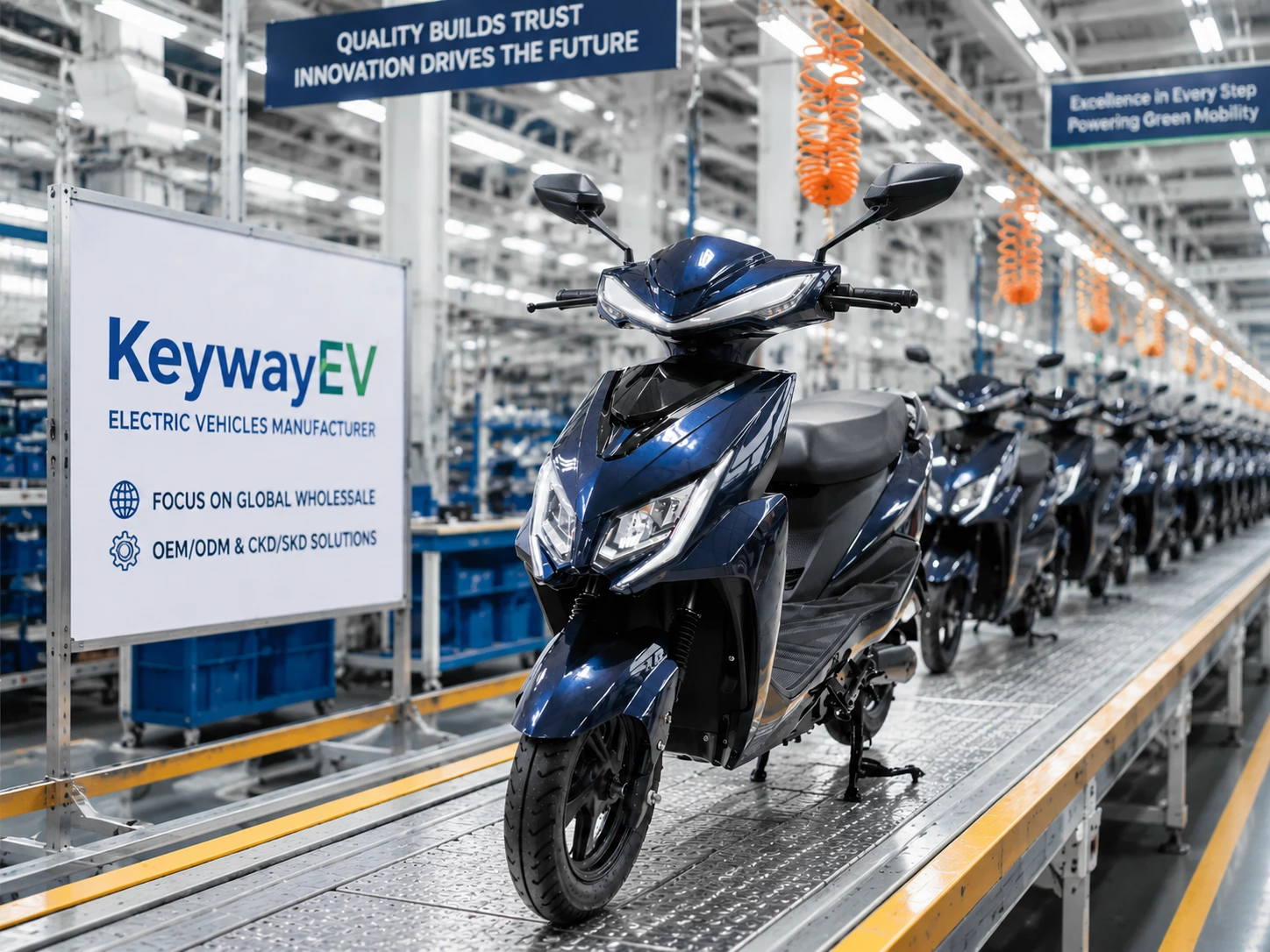
At KeywayEV, we support overseas wholesale partners with electric two-wheelers, OEM/ODM services, and product customization options. For distributors evaluating new models or developing a market-specific lineup, the first step is to identify the requirements of their customers, from vehicle performance to parts support and expected order volumes.
Growing demand creates an opportunity, but long-term success depends on choosing the right products, maintaining quality, and building a dependable supply relationship.
Final Thoughts: Make the Cost of Mobility Work for You
The growing interest in electric two-wheelers reflects a practical shift in how people think about everyday transportation. Instead of focusing only on the upfront price, more buyers are considering energy expenses, maintenance, convenience, and the cost of keeping a vehicle on the road over time.
Electric two-wheelers can offer compelling value for commuters, households, and commercial riders whose travel patterns match the vehicle's capabilities. They are not automatically the best option for every person or every market, but the combination of operating-cost potential and flexible vehicle choices makes them worth serious consideration.
For importers, wholesalers, and distributors, this change also creates an opportunity to build a product lineup around real local needs. The right combination of vehicle specifications, dependable quality, spare-parts support, and customization can make a meaningful difference in a competitive market.
Looking for electric two-wheelers for your wholesale business? Explore KeywayEV's product range and discuss OEM/ODM options with our team to identify models that fit your target market.
Website: https://www.keywayev.com
Contact: +86 13179685671