electric-motorcycle-maintenance
For importers, distributors and fleet operators, the real advantage of a simpler electric motorcycle is not simply fewer parts. It is less maintenance workload, less downtime, and a more predictable operating cost.
When people compare electric motorcycles with petrol motorcycles, the conversation often starts with purchase price, range, battery capacity or top speed.
However, as someone responsible for ensuring the vehicle operates properly, one should view this issue from a different perspective.
What they ought to know is:
How often will this vehicle need service? Which components are likely to wear out? How quickly can a problem be diagnosed? Are spare parts available? And most importantly, how much time will the vehicle spend in the workshop instead of working?
This is where the simpler structure of an electric motorcycle becomes commercially important.
It does not mean an electric motorcycle is maintenance-free. It means that the type, frequency and complexity of maintenance can be significantly different from a conventional petrol motorcycle.
Why Do Electric Motorcycles Have Fewer Moving Parts?
The biggest structural difference is the powertrain.
A conventional petrol motorcycle typically relies on an internal combustion engine, fuel injection or carburetion, lubrication, exhaust, clutch and transmission systems. All of these systems contain components that move, generate heat, experience friction or require periodic adjustment and replacement.
An electric motorcycle has a fundamentally different architecture:
Battery → Controller → Electric Motor → Drive System
The motor converts electrical energy directly into mechanical movement without the combustion process used by a petrol engine.
That removes many systems associated with combustion and engine operation.
There is no engine oil to circulate, no spark plug to ignite fuel, no exhaust system to maintain and, depending on the drivetrain, no conventional clutch or multi-speed gearbox.
But the important point is not simply that there are "fewer parts."
The more meaningful point is that there are fewer mechanical systems that require routine servicing and contain high-friction components.
For a fleet operator, that distinction matters.
What Maintenance Do Electric Motorcycles Actually Need?
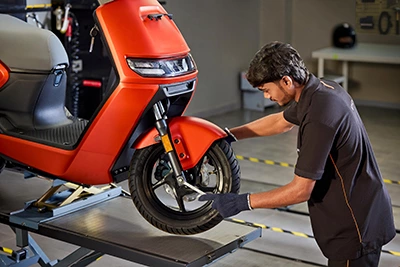
One of the easiest ways to understand the difference is to compare routine maintenance requirements.
| Maintenance Item | Petrol Motorcycle | Electric Motorcycle |
|---|---|---|
| Engine oil | Required | Not required |
| Oil filter | Required | Not required |
| Spark plug | Required | Not required |
| Fuel system service | Required | Not required |
| Exhaust system | Required | Not required |
| Engine tuning | Required periodically | Not applicable |
| Clutch service | Common | Usually not required |
| Gearbox service | Depends on model | Usually not required |
| Battery inspection | Limited | Important |
| Brake maintenance | Required | Required |
| Tire maintenance | Required | Required |
| Suspension inspection | Required | Required |
| Electrical system | Required | Important |
This does not mean every electric motorcycle will have a lower maintenance cost in every market.
Labor rates, battery design, component quality, road conditions and vehicle usage all affect real-world costs.
But structurally, an electric motorcycle removes several categories of routine mechanical service.
That is a meaningful advantage.
What Are the Real Benefits of a Simpler Electric Motorcycle?
From an operator's perspective, the value of simpler construction comes from what happens after the vehicle leaves the factory.
Fewer Routine Maintenance Tasks
The most obvious benefit is fewer scheduled mechanical maintenance procedures.
There is no need to regularly change engine oil, replace spark plugs or service a conventional fuel system.
For a single motorcycle, this may save only a modest amount of money.
For a fleet of 100, 500 or 1,000 vehicles, however, small maintenance tasks become operational workload.
Every service appointment requires:
-
Labor
-
Parts
-
Scheduling
-
Workshop capacity
-
Vehicle downtime
Reducing unnecessary maintenance procedures reduces the workload surrounding the fleet.
Fewer Mechanical Wear Points
An electric motor has a fundamentally different operating principle from an internal combustion engine.
There are fewer high-speed mechanical components involved in generating power, and there is no combustion process inside the power unit.
That can reduce certain sources of mechanical wear.
However, this should not be misunderstood as a guarantee of higher reliability.
An electric motorcycle still depends on the quality of its battery, controller, motor, wiring and mechanical components.
Simple structure reduces some sources of maintenance; it does not eliminate the importance of component quality.
Lower Maintenance Workload
This is particularly important for distributors and fleet operators.
Maintenance cost is not just the price of a replacement component.
It also includes technician time, diagnostic time, transportation, administration and workshop capacity.
If a fleet manager can reduce the number of routine maintenance events, the entire service operation becomes easier to manage.
Less Downtime
For a private rider, maintenance is an inconvenience.
For a commercial fleet, maintenance can become a business cost.
A delivery motorcycle sitting in a workshop is not generating revenue. A passenger vehicle waiting for parts is not carrying passengers. A commercial motorcycle that cannot operate is an unavailable asset.
This is why I prefer to measure maintenance performance through vehicle uptime, not simply maintenance cost.
The equation is straightforward:
Less routine maintenance → fewer workshop hours → greater vehicle availability
For a fleet operator, that can be more valuable than saving a small amount on an oil change.
Does a Simpler Structure Mean an Electric Motorcycle Is Maintenance-Free?
No—and any serious fleet operator should be suspicious of that claim.
Electric motorcycles still require regular maintenance.
Tires wear out. Brake components wear out. Bearings require inspection. Suspension components can deteriorate. Fasteners can loosen under difficult road conditions.
The electrical system also introduces its own maintenance considerations.
Battery condition, connectors, wiring, chargers and controllers all need appropriate inspection and support.
Battery degradation is another important consideration.
Unlike engine oil or spark plugs, the battery is a major energy-storage component whose performance changes over time.
Its lifespan depends on chemistry, temperature, charging behavior, storage conditions, usage patterns and battery management.
Therefore, the correct comparison is not:
Petrol motorcycle = maintenance
Electric motorcycle = no maintenance
The more accurate comparison is:
Petrol motorcycle = more engine and fuel-system maintenance
Electric motorcycle = less routine mechanical maintenance, but greater attention to electrical and battery systems
That distinction is important when evaluating a vehicle for long-term commercial use.
How Does Simpler Maintenance Affect Total Cost of Ownership?
Purchase price is only one part of the cost of operating a motorcycle.
For importers, distributors and fleet operators, a more useful model is Total Cost of Ownership (TCO).
A simplified calculation looks at:
Purchase Price + Energy Cost + Maintenance + Spare Parts + Labor + Downtime + Battery Replacement
This is why comparing motorcycles only by their factory price can be misleading.
A cheaper vehicle may not remain cheaper if it requires more frequent maintenance, has poor spare-parts availability or spends more time out of service.
Likewise, an electric motorcycle with a higher initial purchase price may become more competitive over its operating life if it delivers predictable energy and maintenance costs.
The key word here is predictable.
For a fleet manager, predictable operating expenses are often more useful than an attractive purchase price.
Why Lower Maintenance Matters More for Commercial Fleets and Dealers
The impact becomes much larger when the vehicle is used commercially.
Imagine a fleet with 300 motorcycles.
If every vehicle requires regular workshop attention, the fleet is not dealing with 300 maintenance problems—it is managing hundreds of individual service events.
Now consider the additional cost of:
-
Scheduling technicians
-
Storing spare parts
-
Transporting vehicles
-
Diagnosing faults
-
Waiting for components
-
Managing warranty claims
-
Replacing unavailable vehicles
The maintenance system itself becomes an operational department.
This is why electric motorcycles can be particularly interesting for high-utilization fleets.
The goal is not simply to spend less on maintenance.
The goal is to keep more vehicles available for work.
For distributors, the same principle applies to after-sales service.
A vehicle with a relatively simple powertrain can make some aspects of service easier to organize, but only if the manufacturer provides the necessary spare parts, technical information and support.
What Should Importers and Dealers Consider Before Buying?
A simple electric motorcycle is only a good business product if the entire supply chain behind it is reliable.
Before placing a bulk order, I would evaluate at least seven areas.
1. Battery Quality
Battery performance directly affects range, durability and customer satisfaction.
Ask about battery chemistry, capacity, protection systems, warranty and expected service life.
2. Motor and Controller
These are critical powertrain components.
The advertised motor wattage is not enough. Component quality, thermal management, controller matching and actual operating conditions all matter.
3. Spare Parts Availability
A motorcycle is only as serviceable as its replacement parts.
Importers should understand which parts are normally stocked, how quickly additional components can be supplied and whether parts remain available for older models.
4. After-Sales Support
Technical support should not begin only after a customer has a problem.
Good suppliers should be able to provide technical information, troubleshooting support and appropriate replacement components.
5. Warranty Policy
A clear warranty is important, but the practical process matters even more.
Who diagnoses the problem?
Who supplies the replacement component?
How quickly can the issue be resolved?
These questions are more useful than simply asking how many years the warranty lasts.
6. Local Serviceability
A vehicle designed for one market may not automatically be suitable for another.
Road conditions, climate, payload, daily mileage and service capabilities should all be considered before selecting a model.
7. Long-Term Parts Support
This is particularly important for distributors.
A model may sell well initially, but customers will continue to need parts long after the original order.
A reliable supplier should therefore be able to support the model beyond the first shipment.Explore our electric motorcycle models and evaluate the specifications, configuration options and support requirements for your target market.
How Should Dealers Build a Spare Parts Strategy?
A common mistake is assuming that a simpler vehicle means dealers do not need spare parts.
That is not true.
The smarter approach is to build a focused spare-parts inventory.
High-frequency consumables and common electrical components should normally be easier to access, such as:
-
Brake components
-
Tires
-
Chargers
-
Controllers
-
Throttles
-
Lights
-
Switches
-
Selected suspension components
The objective is not to stock every possible component.
It is to make sure that the parts most likely to be needed are available when customers need them.
For a distributor, this can significantly improve after-sales response time.
Electric vs. Petrol Motorcycle: Which Is Easier to Maintain?
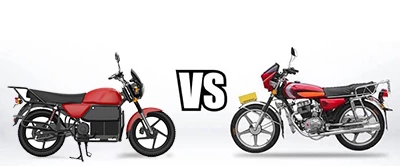
There is no need to claim that one technology wins in every category.
The difference is more specific.
A petrol motorcycle has a larger maintenance workload around its engine, fuel and combustion systems.
An electric motorcycle shifts that maintenance profile toward:
Battery + electrical system + brakes + tires + suspension + drivetrain
For routine mechanical maintenance, the electric motorcycle generally has fewer engine-related service requirements.
For long-term ownership, however, the quality of the battery and electrical components becomes particularly important.
So the better question is not:
"Which motorcycle has no maintenance?"
The better question is:
"Which motorcycle gives my business the most predictable maintenance requirements and the highest useful uptime?"
For commercial operators, that is a much more useful question.
Conclusion: Simpler Structure Is an Operational Advantage
From the perspective of fleet operations, the greatest advantage of electric vehicles cannot simply be summarized as having "fewer components."
The real advantage is what those fewer mechanical systems can mean over thousands of operating hours:
Less routine mechanical maintenance.
Fewer maintenance procedures.
Less workshop workload.
Potentially lower maintenance-related costs.
And, most importantly, more time available for productive operation.
But simple structure alone is not enough.
For importers, distributors and fleet operators, the best electric motorcycle is not necessarily the one with the lowest purchase price or the highest advertised specifications.
It is the one supported by a complete ecosystem:
Reliable components + practical design + available spare parts + technical support + dependable after-sales service.
That is where the real business value of a simpler electric motorcycle begins.
The goal is not simply to build a vehicle that is easier to maintain. The goal is to keep that vehicle working.